
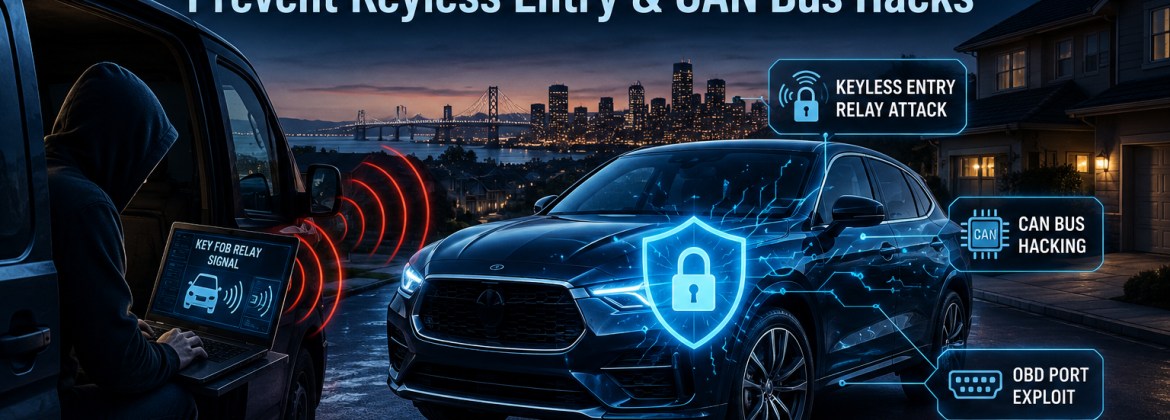
Car cybersecurity 2026 has become a necessity for Bay Area drivers as vehicle theft continues to evolve. The hotwire and crowbar are largely relics of a previous era. The thief who targets your vehicle today is more likely to be sitting in a van outside your home with a laptop and a software-defined radio than breaking a window. In 2026, the most sophisticated and increasingly common forms of vehicle theft exploit the very technology that was designed to make your car more convenient and secure. Relay attacks on keyless entry systems, CAN bus injection attacks through the OBD port, and push-to-start system exploits now account for a significant and growing share of auto theft incidents across California. Alameda County, which includes Hayward, Fremont, and Oakland, has consistently ranked among the highest-risk areas in the state for vehicle theft over recent years, making cybersecurity awareness not an abstract tech topic but a practical necessity for every car owner in this region.
Need Advanced Vehicle Security?
Call Us Now: +1 510-930-0881
This guide explains exactly how each of these attack methods works, what makes your specific vehicle vulnerable, and what steps you can take right now to protect yourself, ranging from simple behavioral changes to professional-grade electronic countermeasures that Audiomobile Hayward installs for Bay Area drivers.
Understanding the New Generation of Car Theft in the Bay Area
Before diving into specific attack types, it helps to understand the broader shift that has occurred in how modern vehicles are stolen. A 2024 study by the Insurance Institute for Highway Safety found that vehicles equipped with modern keyless entry and push-to-start systems are stolen at a rate disproportionate to their prevalence on the road. The same technology designed to provide seamless, frictionless access has created attack surfaces that sophisticated thieves know how to exploit.
The Bay Area, with its high concentration of tech-savvy criminals, high-value vehicle population (particularly Hondas, Toyotas, Hyundais, and Kias, which remain perennial targets), and dense residential areas where cars sit unattended overnight, creates an environment where electronic car theft methods are particularly prevalent. Understanding what you are up against is the first step toward meaningful protection.
Relay Attacks on Keyless Entry Systems: How They Work and Why They Are So Effective
What a Relay Attack Actually Is
A relay attack is a form of electronic theft that exploits the radio frequency communication between your key fob and your vehicle. Modern keyless entry systems work by emitting a low-power radio signal from the key fob that the car continuously scans for. When the car detects the key within a certain range, it unlocks automatically. When the key is close enough during a start attempt, the push-to-start system recognizes it and allows ignition.
In a relay attack, two thieves work as a team. One stands near your home with a relay device that amplifies and transmits the signal from your key fob inside the house. The second stands near your car with a receiving unit. The car receives what appears to be the legitimate key signal and unlocks. The second thief enters and drives away. The entire operation typically takes less than sixty seconds and leaves no physical evidence of forced entry.
Why Your Car Cannot Tell the Difference
The core vulnerability of relay attacks is that most standard keyless entry systems authenticate based on signal presence, not signal origin or distance. Your key fob is designed to be passive, meaning it broadcasts its signal continuously when it senses the car attempting to communicate. The car has no built-in way to determine whether the signal it receives is coming from two feet away or has been electronically relayed from fifty feet away through an amplifier.
This is not a flaw introduced by a specific manufacturer. It is a fundamental characteristic of the radio frequency identification and low-frequency communication protocols that underpin most keyless entry systems manufactured before 2023. Even expensive luxury vehicles from European manufacturers have been documented as vulnerable to this attack.
Which Bay Area Vehicles Are Most at Risk
While virtually any vehicle with passive keyless entry can theoretically be targeted, certain models have been documented more frequently in Bay Area theft reports. Honda CR-Vs and Pilots, Toyota RAV4s and Priuses, Range Rovers, and Mercedes-Benz models with older keyless entry implementations have all appeared repeatedly in local theft documentation. The higher the resale value of the vehicle and the older the keyless entry system implementation, the more attractive it is as a relay attack target.
If you have already experienced vehicle security concerns or want to understand your specific vulnerabilities, read our overview of how rising theft in Hayward is affecting drivers.
CAN Bus Hacking: The Most Technically Advanced Threat
What Is the CAN Bus and Why Does It Matter
The Controller Area Network bus, universally known as the CAN bus, is the communication backbone of your vehicle. Introduced as a standard in the late 1980s and now present in essentially every modern vehicle, the CAN bus is a network that allows all of the electronic control units in your car to communicate with one another without requiring a central processing host.
Your engine control unit, transmission module, braking system, airbag controller, door lock actuators, instrument cluster, and infotainment system all communicate over the CAN bus. When you press the brake pedal, a signal travels across the CAN bus. When your car detects a collision, the airbag module receives the command via the CAN bus. When you press the start button, the body control module communicates with the ignition system across the CAN bus.
The CAN bus was designed in an era when vehicle networks were closed systems that never communicated with the outside world. Security was never a design priority because physical access to the vehicle was assumed to be the only access vector. In 2026, that assumption is outdated.
How CAN Bus Injection Attacks Work
A CAN bus injection attack, also sometimes called a CAN bus hacking or CAN bus injection, involves physically accessing the CAN bus network, typically through the OBD II diagnostic port under the dashboard, and injecting malicious commands that override the car’s normal operation.
In the context of vehicle theft, the most common CAN bus attack involves a thief gaining brief access to the OBD port, either by breaking the door glass or by using a relay attack to open the car first, and connecting a small device that injects the CAN bus command to authorize the engine start sequence. This bypasses the immobilizer entirely because the attack speaks the same language as the car’s own electronic systems.
More sophisticated CAN bus attacks documented in security research include remote code execution through compromised infotainment systems that have internet connectivity, attacks through Bluetooth or Wi-Fi interfaces that reach the internal vehicle network, and even over-the-air update mechanisms that have been exploited in research environments.
The OBD Port as a Primary Attack Vector
The OBD II port is present in every vehicle sold in the United States since 1996. It sits below the dashboard on the driver’s side, typically within easy reach, and provides direct access to the CAN bus. This port was designed for mechanics and diagnostic equipment. It was never designed with the assumption that an attacker might use it.
In documented theft cases, criminals have been known to break the small driver’s side window (the cheapest glass on most vehicles), insert a device into the OBD port, and complete the engine start sequence in under a minute. The OBD port device is typically a small purpose-built tool that communicates the correct start authorization commands to the body control module.
Blocking or protecting the OBD port is therefore a meaningful security measure for drivers in high-risk areas like Hayward and the broader Bay Area.
For an overview of how your vehicle’s electrical systems interact and how vulnerabilities develop, visit our electrical troubleshooting page for more context.
Push-to-Start System Vulnerabilities
Why Push-to-Start Is Both Convenient and Exploitable
Push-to-start systems have replaced the traditional ignition key in the majority of new vehicles sold in the United States. The convenience is real: you walk up to your car with the fob in your pocket, grab the door handle, and the car unlocks. You press the start button and the engine runs. No key insertion required.
The problem is that this seamless experience is built on the same passive radio frequency handshake described in the relay attack section above. Push-to-start systems continuously broadcast a low-frequency interrogation signal from the car, waiting for a key fob response within range. A relay attack extends that effective range across the wall of your home. The car has no way to know the fob is sitting on your kitchen counter rather than in your pocket.
The UWB Upgrade That Many Vehicles Still Lack
Ultra-wideband radio technology (UWB) offers a genuine solution to relay attacks because it measures the round-trip signal time with enough precision to determine whether the key is actually within the required physical proximity. A relayed UWB signal arrives too late to pass the proximity check, defeating the relay attack.
The problem is that UWB implementation in vehicle keyless entry systems is still relatively recent. Apple’s AirTag uses UWB. Modern iPhone models use it for spatial awareness. Several manufacturers, including BMW, Audi, and Tesla, began implementing UWB in their keyless entry systems in the 2023 and 2024 model years. However, the overwhelming majority of vehicles on Bay Area roads today do not have UWB-based keyless entry, leaving them vulnerable to relay attacks.
The specific vulnerabilities of push-to-start systems in Bay Area vehicles and the countermeasures that work are discussed in depth in our article on push-to-start theft in Hayward and how kill switches address it.
Practical Protection: What Bay Area Drivers Can Do Right Now
The good news is that countermeasures exist for every attack type described above. Some are free behavioral changes. Others are inexpensive hardware solutions. And some are professional-grade electronic security systems that provide layered protection across multiple attack vectors simultaneously.
Use a Faraday Pouch for Your Key Fob
A Faraday pouch is a small wallet or bag lined with metallic material that blocks radio frequency signals from entering or leaving the pouch. When your key fob is inside a Faraday pouch, the relay attack device outside your home has nothing to amplify because the fob’s signal cannot escape the pouch.
This is the simplest and least expensive countermeasure available. Quality Faraday pouches are available for under twenty dollars and are the most immediate action any keyless entry vehicle owner can take. The behavioral change required is simply placing your key fob in the pouch when you are at home, particularly overnight when most relay attacks occur. Test your pouch regularly by placing your fob inside, sealing it, and confirming that approaching your car does not trigger the unlock response.
A similar principle applies to metal containers. Some drivers store key fobs in small metal tins or even the microwave (which is a Faraday cage), though a purpose-made Faraday pouch is more practical for daily use.
Disable Passive Entry When Not Needed
Many keyless entry systems allow you to disable the passive unlock feature through the vehicle settings, requiring you to press a button on the fob to unlock rather than simply approaching the car. This eliminates the relay attack vulnerability entirely when enabled because the fob only transmits when you actively press the button, not passively in response to the car’s interrogation signal.
Check your vehicle’s settings menu or owner’s manual for options like passive entry, walk-away locking, and hands-free unlock. On many vehicles these can be toggled off. The minor reduction in convenience is substantially outweighed by the security improvement in high-theft areas.
Protect Your OBD Port
OBD port locks are physical devices that install into the diagnostic port and require a key to remove. They prevent a thief who has gained entry through a relay attack or broken glass from quickly inserting a CAN bus injection device. While not impenetrable, an OBD port lock significantly slows the attack and may cause the thief to abandon the attempt in favor of an easier target.
OBD port locks are available from various manufacturers and are compatible with nearly all vehicle makes and models. Combined with other countermeasures, they form an important layer of physical security against the CAN bus injection attack vector.
Install a Kill Switch
A kill switch is a hidden interrupt in a critical circuit in your vehicle, typically the fuel pump circuit, ignition circuit, or starter circuit, that prevents the car from starting even if the attacker has successfully executed a relay attack or CAN bus injection. The kill switch location is known only to you. Without activating it, the car simply will not start regardless of what electronic commands have been accepted.
Kill switches are one of the most effective countermeasures against the full combination of keyless entry exploits because they operate at a physical layer that electronic attacks cannot reach. A relay An An attacker who successfully unlocks the car and attempts to start it via CAN bus injection will still be stopped if the kill switch circuit is open.
Audiomobile Hayward installs hidden kill switches for Bay Area drivers. Read our detailed guide on kill switch installation for 2026 vehicles in Hayward to understand how they work and why they remain effective against electronic theft methods.
Install a Professional Vehicle Alarm System
Modern professional-grade vehicle alarm systems provide layers of protection that factory systems and relay attack countermeasures alone cannot replicate. A well-specified alarm system includes tilt and shock sensors that trigger if the vehicle is moved or struck, interior motion detection that activates if someone enters the vehicle, CAN bus monitoring that detects abnormal communication patterns, and remote notification that alerts you immediately on your phone.
The shock sensor is particularly relevant for CAN bus injection protection because a thief who breaks the small driver’s window to access the OBD port will trigger the shock sensor before they can complete the attack.
Visit our alarm installation page
Consider Compustar Security Systems
Compustar is one of the leading professional vehicle security and remote start system brands in the industry. Compustar’s advanced security systems integrate two-way communication between the vehicle and your smartphone, sophisticated intrusion detection that goes well beyond basic glass-break and shock sensing, and anti-theft features that are specifically designed to counter modern electronic theft methods.
The Compustar T13 in particular has become a popular choice among Bay Area drivers who want comprehensive protection against both traditional theft methods and modern electronic exploits. Its integration with the DroneMobile platform allows real-time GPS tracking, remote immobilization, and instant theft alerts sent directly to your phone.
Read our deep dive into how the Compustar T13 and kill switch combination protects against modern theft for specifics on this system’s capabilities.
Add GPS Tracking for Recovery When Prevention Fails
No security system is impenetrable, and a layered approach to protection acknowledges that prevention and recovery are equally important. A professionally installed GPS tracking device that is hidden within the vehicle provides law enforcement with the information they need to locate and recover your vehicle if it is stolen despite all other measures.
GPS trackers have evolved significantly in recent years. Modern units operate on cellular networks, update their location in near real-time, send geofence alerts when the vehicle leaves a defined area, and can be monitored via smartphone apps. Unlike the visible OBD-port GPS dongles that a thief can quickly remove, a professionally installed hidden unit is substantially more difficult to locate and disable.
For a comprehensive overview of GPS tracking options and how they integrate with vehicle security in California, visit our complete GPS tracking guide and read our article on
Layered Security: Why No Single Countermeasure Is Enough
The most effective approach to car cybersecurity in 2026 is layered protection that addresses multiple attack vectors simultaneously. Here is how the layers work together:
- Layer 1 (Signal blocking): Faraday pouch prevents relay attack from amplifying your key fob signal when the car is parked.
- Layer 2 (Physical deterrence): Steering wheel lock or visible deterrent creates a time cost for the thief even if they access the vehicle.
- Layer 3 (OBD protection): OBD port lock prevents quick CAN bus injection even if the thief enters the vehicle.
- Layer 4 (Electronic detection): Professional alarm system with shock, tilt, and motion sensors triggers immediately if the vehicle is entered or disturbed.
- Layer 5 (Start prevention): Kill switch stops the vehicle from starting even if all electronic authentication has been bypassed.
- Layer 6 (Recovery): GPS tracker enables law enforcement to locate the vehicle if it is moved despite all other measures.
Each layer independently reduces the risk. Together, they create a security profile that makes your specific vehicle a far less attractive target than the unprotected car next door. Thieves, like all opportunists, prefer easy targets. Sufficient friction causes them to move on.
CAN Bus Security for Connected and Newer Vehicles
The Growing Threat Surface of Internet-Connected Cars
If your vehicle was manufactured in the last four or five years, it almost certainly has some form of internet connectivity, whether through an embedded cellular modem, a Wi-Fi hotspot capability, or a Bluetooth interface that communicates with smartphone apps. This connectivity has made vehicles part of the Internet of Things in a way that introduces entirely new attack surfaces.
Security researchers have documented vulnerabilities in multiple manufacturers’ telematics systems, over-the-air update mechanisms, and mobile app interfaces. In several high-profile demonstrations, researchers have been able to send commands to vehicles remotely through compromised backend systems. While these large-scale infrastructure attacks are difficult to execute in the real world and typically require significant resources, they represent the direction that automotive cybersecurity threats are moving.
For most Bay Area drivers, the practical implications are: keep your vehicle’s software updated when manufacturer updates are available, be cautious about third-party applications that claim to interface with your vehicle, and understand that connected vehicle features come with security tradeoffs.
Infotainment Systems as a Gateway
Modern infotainment systems in many vehicles have network connectivity and run software platforms that have known vulnerabilities. A malicious USB drive, a compromised Bluetooth connection, or a malicious app downloaded to an integrated app store can all serve as entry points that a sophisticated attacker might use to access deeper vehicle systems.
The countermeasures for this threat vector are largely behavioral: do not plug unknown USB devices into your vehicle, keep Bluetooth visibility set to non-discoverable when not actively pairing, and be selective about what applications you connect to your vehicle’s infotainment system.
For more on how your vehicle’s stereo and infotainment system integrates with the broader vehicle network, visit our stereo page for information on aftermarket systems that can improve both functionality and control over your infotainment configuration.
What Thieves Target Most in Hayward and the Bay Area in 2026
Understanding the target profile helps Bay Area drivers assess their own risk level accurately.
High-Theft Vehicle Models
Certain models remain perennial targets in the Bay Area despite differences in security technology. Honda Civics and CR-Vs, Toyota Camrys and RAV4s, Hyundai Sonatas and Tucson models, Kia Sportages, and Chevrolet full-size trucks and Silverados consistently appear at the top of local theft reports. Many of these vehicles are targeted because of their prevalence (making them easy to blend in when driving a stolen one), known vulnerabilities in specific year ranges, and high demand for their parts in the secondary market.
While not strictly a cybersecurity issue, catalytic converter theft surged dramatically in Alameda County in recent years and continues to affect Bay Area drivers. Vehicles targeted most include the Toyota Prius (due to the high palladium content in its hybrid system catalytic converters), Honda Elements, and various trucks and SUVs with high ground clearance. A comprehensive vehicle security approach should include catalytic converter protection alongside electronic security measures.
Commercial and Service Vehicles
Contractors’ trucks, service vans, and commercial vehicles are increasingly targeted both for the vehicle itself and for the tools and equipment stored inside. If you operate a commercial vehicle in the Bay Area, the electronic security considerations above apply with additional urgency since the content value often exceeds the vehicle value. Alarm systems with interior motion detection and cargo area sensors are particularly relevant for this segment.
Read our guide on equipping service trucks with alarm systems in the Bay Area for specifics on commercial vehicle security.
Frequently Asked Questions
1. Can my car really be stolen without touching the key fob?
Yes. In a relay attack, thieves use two devices to amplify the signal between your key fob inside your home and your car outside. The car receives what appears to be the legitimate signal and unlocks. A Faraday pouch stored with your key fob overnight is the most immediate countermeasure.
2. How do I know if my car is vulnerable to relay attacks?
If your car has passive keyless entry, meaning it unlocks automatically when you approach without pressing any button, it is potentially vulnerable to relay attacks. This includes virtually all vehicles with push-to-start systems manufactured before 2023. Newer vehicles with ultra-wideband keyless entry are significantly more resistant but may still have other vulnerabilities.
3. What is CAN bus injection, and how is it different from a relay attack?
A relay attack exploits the wireless communication between your key fob and the car to unlock and start it. A CAN bus injection attack involves physically connecting to the vehicle’s internal network through the OBD diagnostic port and sending commands that authorize starting the engine. The two attacks are sometimes used in combination: a relay attack opens the car, then a CAN bus injection device is inserted through the OBD port to enable the start sequence.
4. Does a factory alarm protect against CAN bus injection?
Standard factory alarms typically monitor the door switches, hood switch, and ignition. They are generally not designed to detect CAN bus injection attacks or to monitor for abnormal traffic on the vehicle network. A professional aftermarket alarm system with shock and motion sensing provides meaningfully better protection because it will trigger when the driver’s window is broken to access the OBD port.
5. Is a steering wheel club still worth using in 2026?
Yes. While it provides no electronic security, a visible steering wheel lock creates a time cost for thieves and serves as a visual deterrent. A thief who successfully executes a relay attack or CAN bus injection but then faces a steering wheel lock must break or cut the device before driving away, which adds time and noise and may cause them to abandon the vehicle. Visible deterrents remain a valid layer in a multi-layered security approach.
6. Can a Faraday pouch fail?
Yes. Cheap Faraday pouches with inadequate shielding material may allow signal leakage at certain frequencies. Test your pouch by placing your key inside, sealing it, and walking up to your locked car. If the car does not respond, the pouch is working. If the car unlocks when you approach, the pouch is not adequately shielding and should be replaced.
7. Will a GPS tracker help me get my car back if it is stolen?
GPS tracking significantly improves recovery rates when law enforcement responds promptly. Studies of vehicle theft recovery in California consistently show higher recovery rates for tracked vehicles when owners can provide real-time location data to police. However, recovery is not guaranteed. The GPS tracker is best understood as a recovery tool that complements prevention-focused measures, not as a substitute for them.
Many insurance providers offer discounts for vehicles with professionally installed aftermarket security systems, GPS tracking, and anti-theft devices. The discount varies by insurer and the specific equipment installed. Contact your insurance provider to confirm what qualifying devices they recognize and what documentation they require after installation.
Read our companion blog on how dash cams can affect your insurance for related information on how aftermarket electronics can impact your coverage and premiums.
9. Can I protect my vehicle against CAN bus hacking without installing new hardware?
Partially. An OBD port lock is a hardware addition but a very minor one, and it meaningfully reduces CAN bus injection vulnerability. Behavioral measures like keeping your vehicle in a locked garage, not leaving it unattended in high-risk areas for extended periods, and keeping software updated all reduce risk without significant hardware investment. However, for comprehensive protection in a high-theft area like the Bay Area, professional security hardware provides a substantially higher level of assurance.
10. What should I do if I suspect my car was almost stolen via a relay attack?
If you notice your car was unlocked when you did not expect it, or if you observe unfamiliar vehicles or individuals near your car who move away quickly when you approach, take the following steps: Confirm your car was actually accessed by checking for signs of entry; contact Hayward police to file a report even if the theft was unsuccessful (pattern data helps law enforcement); and contact Audiomobile Hayward to discuss a security assessment and upgrade. An attempted relay attack strongly suggests your vehicle model is being actively targeted in your area.
How Audiomobile Hayward Protects Bay Area Drivers Against Electronic Car Theft
Audiomobile Hayward has been providing vehicle security solutions for Bay Area drivers for years. Our team stays current with the evolving landscape of vehicle theft methods and the countermeasures that work against them. We understand that security in 2026 is not about a single alarm system but about building a layered protection profile that addresses the specific vulnerabilities of your vehicle and the specific threat environment of your area.
Our security services for Bay Area vehicles include:
- Professional alarm system installation with shock, tilt, motion, and intrusion sensors
- Compustar security system installation, including the T13 with DroneMobile GPS integration
- Hidden kill switch installation in fuel pump, ignition, or starter circuits
- GPS tracker installation in locations that are difficult for thieves to discover and remove
- OBD port protection device installation
- Security system consultation and threat assessment for your specific vehicle and location
To compare security system options, read our analysis of Compustar versus Viper systems for Bay Area drivers and our overview of
Schedule Your Vehicle Security Assessment in Hayward
The most effective security upgrade starts with understanding your specific vehicle’s vulnerabilities and your specific risk environment. Audiomobile Hayward provides security consultations for Bay Area drivers that result in a clear, prioritized recommendation for the protection measures that will deliver the most meaningful risk reduction for your situation.
Do not wait until after a theft attempt to take action. In a high-theft region like Hayward and the broader Bay Area, proactive security investment pays for itself many times over.
Contact Audiomobile Hayward on our contact page to schedule your vehicle security consultation. Our team serves drivers across Hayward, Fremont, Oakland, San Jose, and the entire Bay Area.
Stay Connected with Audiomobile
Follow Audiomobile for the latest updates on vehicle security, car technology, and automotive protection tips.
Need Advanced Vehicle Security?
Call Us Now: +1 510-930-0881
David Trinh